

The Court of Master Sommeliers
The Learning Portal.
Read our Journal. Study online for your upcoming CMS exam. Share your official digital ID card.


What is this website?
The Court’s learning portal for sommelier students. Read the Journal, study for your CMS exam and get your digital ID card, all in one place.
Register for your CMS exam on the Court’s main website.
The Journal
Open to everyone. Built by our sommelier community.
Stay up to date with the Court’s latest news. Find every study source in one place. Check the CMS study syllabus online. Read interviews with Master Sommeliers, in their own words.
- For everyone
- The Court’s latest news, and interviews with Master Sommeliers.
- For students
- Every study source in one place: the syllabus, the study documents, the toolbox, and your name in the results.

What is in the Journal
- The Digital SyllabusType a wine region and see what each level asks. The Court’s syllabus, subject by subject and level by level.Search the syllabus →
- InterviewsMaster Sommeliers, in their own words.Read the interviews →
- The Examinations, ExplainedIntroductory, Certified, Advanced and Master Sommelier: each course and examination, how long each level takes, its fees, pass marks and resits.Understand the exams →
- Course Results & NewsPassed a level? Find your name. Results and photographs from every examination, as the Court publishes them.See results and news →
- The Candidate ToolboxThe Court’s open-source documents and links, in one place.Open the toolbox →
- The Study DocumentsThe tasting workbook, the grape markers and the service standards.See the documents →
- Sommelier LifeCareers, service, and the people who shaped the trade.Read Sommelier Life →
- The PortalHow the study portal works: how to register, what the ID card is, and what is coming next.Read the guides →

CMS AI Learning Portal
Increase your passing rate.
The Court built this learning portal for sommeliers studying a CMS course. Our Sommelier book and our syllabus notes, made digital. Prepared for Introductory and Certified candidates of the Court. A refresher for Advanced.
Easy to start: register free. For everything inside, choose a paid place: £40 for six months or £60 for a year.
- For everyone
- Study at your own pace, on your phone or your laptop.
- For students
- The book, maps, quiz, pronunciation, assisted learning and notes, all set for the Court’s examinations.
- For partners
- One place for your team to prepare for the Court’s exams.
Which level is it for?
 Introductory
Begin here. The book is the syllabus, and the presentations mark exactly what is expected of you at this level.
 Certified
The heart of the portal. Every chapter, every term and every quiz is set for the Certified standard.
 Advanced
Come back to sharpen. Terms and pronunciation are the quickest things to lose, and the fastest to recover.
What is inside
- 8 chaptersThe 6th edition book
The whole book: 112 sections, unabridged, on any screen.
- 51 mapsMaps
Every wine region the syllabus asks you to know.
- 578 questionsQuiz
Every question written from the book, with the reasoning.
- 1,985 namesPronunciation
Hear every appellation, grape and producer said properly.
- 149 presentationsAssisted learning
The Court’s own syllabus presentations, marking what each level expects of you.
- Note taking
Your notes, bookmarks and where you left off, kept on every device.
- 146 termsGlossary
The vocabulary of the trade, defined.
- The deductive tasting grid
Practise the Court’s tasting format, with its own vocabulary.
How to become a member
- ChooseSix months or a year. Both open everything.
- Pay by cardSecurely through Stripe. The Court never sees your card.
- Start studyingYour place opens as soon as the payment clears.
- Stop whenever you likeTwo clicks from your account. You keep the term you have paid for.
- 14 days to change your mindFull refund if the portal is not for you — see refunds.
- A failed card does not lock you out14 days stay open while your bank is asked again.
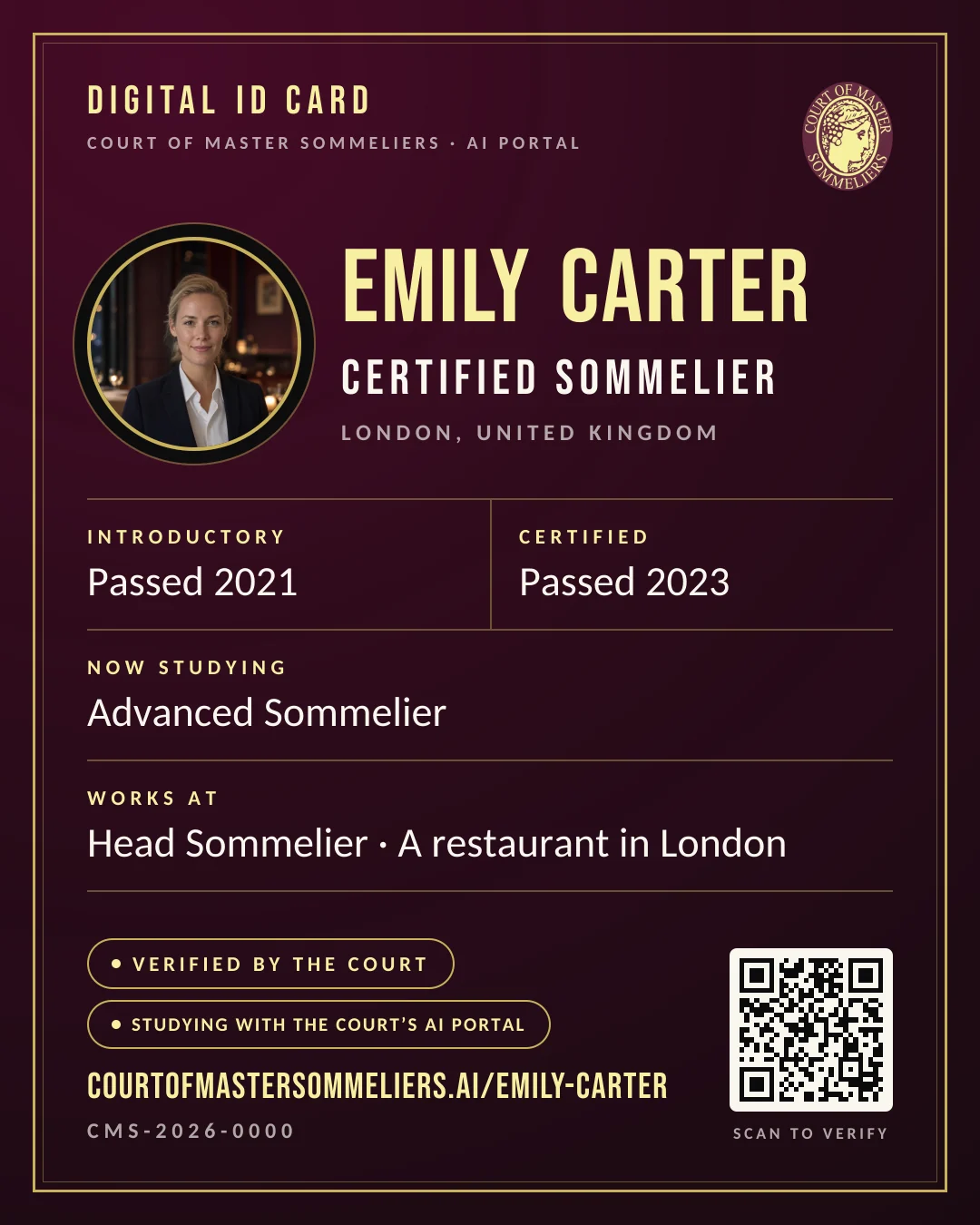
The digital ID card
Verified by the Court. Share it across your digital world.
- One link, everywhereYour CV, your Instagram bio, your LinkedIn.
- Proof anyone can checkA QR code that shows your levels are real.
- Grows with your careerPass the next exam and add the year.
- FreeYou only need an account.
Get yours in 3 steps
- RegisterAn account takes a minute.
- ApplyYour name, your photo, the examinations you passed.
- The Court checks itWithin 1 to 4 business days. Approved, your card goes live.












Integrity · Hospitality · Humility