Professional and friendly wine service is an important part of the Court’s examinations, along with theory and tasting ability. The Service Standards set out how that service is done, from glassware polished before the doors open to the last pour from a decanter.
They are written as a sequence, and the sequence matters. These are the parts candidates meet most often, in the order the document gives them.
01Before service: mise en place
Mise en place is the preparation done before the first guest sits down. Wine lists must be clean, correct, up to date and easy to read, and wines stored neatly and organised correctly. Glassware must be clean and free from odour: steamed over hot water, then polished bowl first and stem and foot last, with a clean, lint-free microfibre, linen or cotton cloth. Nylon and man-made fibres repel water.
Service cloths are folded, bottle-opening tools organised, and ice buckets, coasters, decanters and decanting tools set out. Glass stemware is the only thing that touches the tablecloth. Bottles, decanters and corks go on an underliner or coaster, cleaned and polished before service. Wherever possible, beverage service is performed to the right of the guest.
02The standard service, step by step
Every bottle follows the same sequence, and the other services build on it. Glassware is placed identically for each guest, starting with the person to the left of the host and continuing clockwise to finish with the host.
At the table, service moves clockwise: ladies first, gentlemen second and the host last, whatever their gender. A guest of honour is served before anyone else, and in parties of eight or more it is acceptable to serve everyone clockwise. Twist the bottle slightly at the end of each pour and wipe the neck with the service cloth, so nothing drips onto the table.
- 1Take the orderStand to the right of the guest and repeat the vintage, producer and vineyard to confirm the choice.
- 2Present the bottleTo the host, label side up on a clean service cloth, repeating the vintage, producer and vineyard.
- 3Cut the foilBelow the second lip, so the wine cannot drip behind it. The foil goes in your pocket.
- 4Draw the corkInsert the worm just off centre, stop just before the bottom of the cork, and lever it out without a pop.
- 5The host tastesPour about 50ml, step back and wait for the host to approve the wine.
- 6Serve the tableFill glasses one third to half full, depending on the size of the glass.
03Sparkling wine and decanting
Sparkling wine is a test of control. Serve it cold, with a bucket of iced water deep enough to cover the bottle up to the neck. Keep a hand or thumb over the cork while the cage is untwisted with six full turns, always point the cork away from the guest towards the ceiling, and twist the bottle away from the cork at 45°, in the air or in the bucket but never against the body. The cork is released gently, with little or no noise. Pour in a single stream, two pours if necessary, and complete one guest’s pours before moving on to the next.
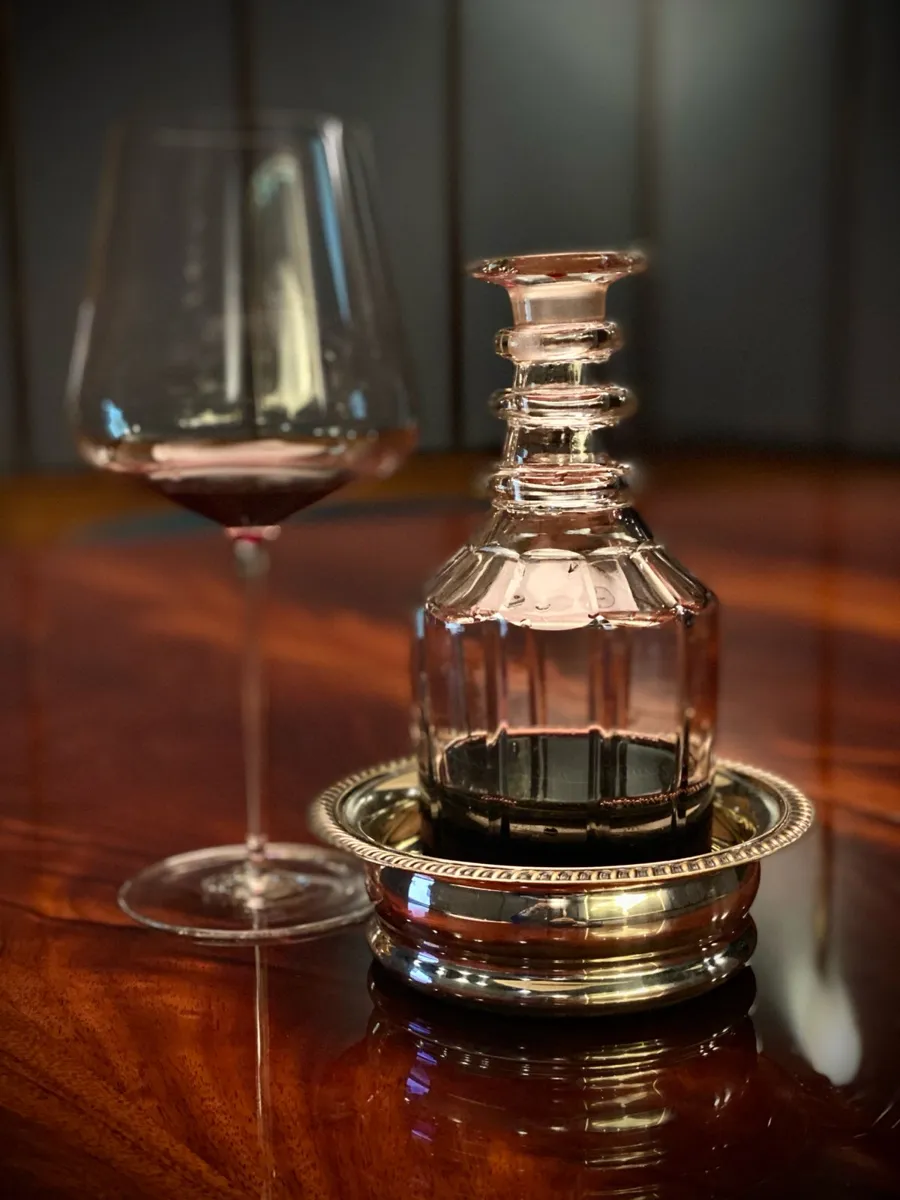
An old red is decanted off its sediment. A guéridon is indispensable, with the decanter, candle, matches, corkscrew, service cloth and underliner set on it before it goes beside the table. The bottle travels label upwards in a lined basket, so the sediment is not disturbed. Watching the candle light through the bottle neck, pour slowly and steadily in a single pour, and stop when the sediment appears in the neck. Decanting is also theatre: place the guéridon where the whole table can see it, and work calmly and confidently while answering the guests’ questions.
- Non-vintage at 6–8°C, vintage at 8–12°C
- Six full turns of the cage, thumb on the cork
- Cork away from the guest, bottle at 45°
- Released with little or no noise
- Everything on the guéridon first
- Bottle label upwards in a lined basket
- Candle light through the bottle neck
04Storage and serving temperatures
Store wine at a constant 10–13°C, lying down and label up: moisture keeps the corks intact, and label up makes stocktaking easier and shows where the sediment has settled. Spirits are stored standing up. Never store wine in strong light, damp, vibration or excessive heat, or upright for more than a few weeks unless it has a twist-off closure.
Before buying older wines, ask how they have been stored and when they were shipped from the winery cellar, and inspect the bottles for label damage, leakage and ullage.
Questions candidates ask
At what temperature is Champagne served?
Non-vintage at 6–8°C and vintage at 8–12°C, in a bucket of iced water deep enough to cover the bottle up to the neck.
How much wine does the host taste?
About 50ml. Step back and wait for the host to approve the wine before serving the table.
How should wine be stored?
At a constant 10–13°C, lying down and label up, away from strong light, damp, vibration and excessive heat.
The same sequence, every bottle, every table.
Sources
- Court of Master Sommeliers, Service Standards 24.1